

Commentary
Alexandra Prokopenko
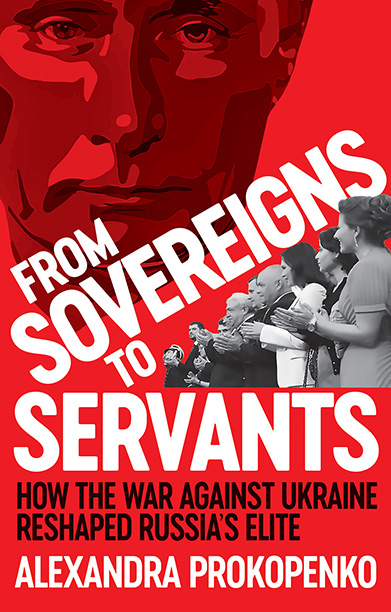
How did Putin co-opt Russia’s political and economic elites, ensuring no more than fitful resistance to the regime’s war on Ukraine?
When Moscow launched its full-scale invasion of Ukraine, the West slapped crushing sanctions on Russia. Many expected the country’s elite—prominent liberals and global businessmen—to defend their assets and cosmopolitan lifestyles by forcing Putin to stop the war. Instead, liberal-minded officials rewired the economy for war; corporations obeyed new rules; and only a handful resigned or spoke out. Why?
Built on dozens of candid conversations with top Russian officials and businessmen since the mid-2010s, this book dissects their moral reasoning, and how their boundaries of ethical acceptability expanded over time, in line with the expectations of their superiors. Though the Russian upper class retained formal attributes of power, in reality it lost its agency, essentially becoming a mere instrument of governance.
Alexandra Prokopenko illuminates the war’s pivotal moments: Western sanctions, mass mobilisation, the annexation of four Ukrainian regions, and Yevgeny Prigozhin’s aborted mutiny in 2023. She traces meticulously how competing factions, from technocrats to hawks, rationalised each shock and recalibrated their loyalties. And she sets this process within an inside history of Putin’s regime, analysing the transformation of mindset at individual and sociological levels. These people will continue influencing global politics; we must understand how they think and act.

Senior Fellow, Carnegie Russia Eurasia Center
Alexandra Prokopenko is a senior fellow at the Carnegie Russia Eurasia Center.
Recent Work
Alexandra Prokopenko
Alexandra Prokopenko
Carnegie does not take institutional positions on public policy issues; the views represented herein are those of the author(s) and do not necessarily reflect the views of Carnegie, its staff, or its trustees.

If the Russian-speaking community in Latvia cannot articulate their interests without being seen as disloyal, they could end up embracing a pro-Kremlin agenda.

Sergejs Potapkins

Russia’s ruling party would have benefited from Putin appearing as its distant patron, but as an active frontman imposing his views on the public, he has done nothing but harm both the party’s election campaign and the ruling system overall.

Andrey Pertsev

Depleted financial reserves and a shrinking tax base mean it is no longer possible to simultaneously deliver high defense spending, price stability, and economic growth.
Alexandra Prokopenko
Blurring the line between humans and animals is a long-standing tradition in social utopian prose. In his latest novel, Leonid Bershidsky reminds us that in social experiments, people are often treated no differently than animals.

Alexander Baunov

In the tenth year of his presidency, President Mirziyoyev’s system is becoming even more personalized than that of his predecessor Karimov.

Galiya Ibragimova